
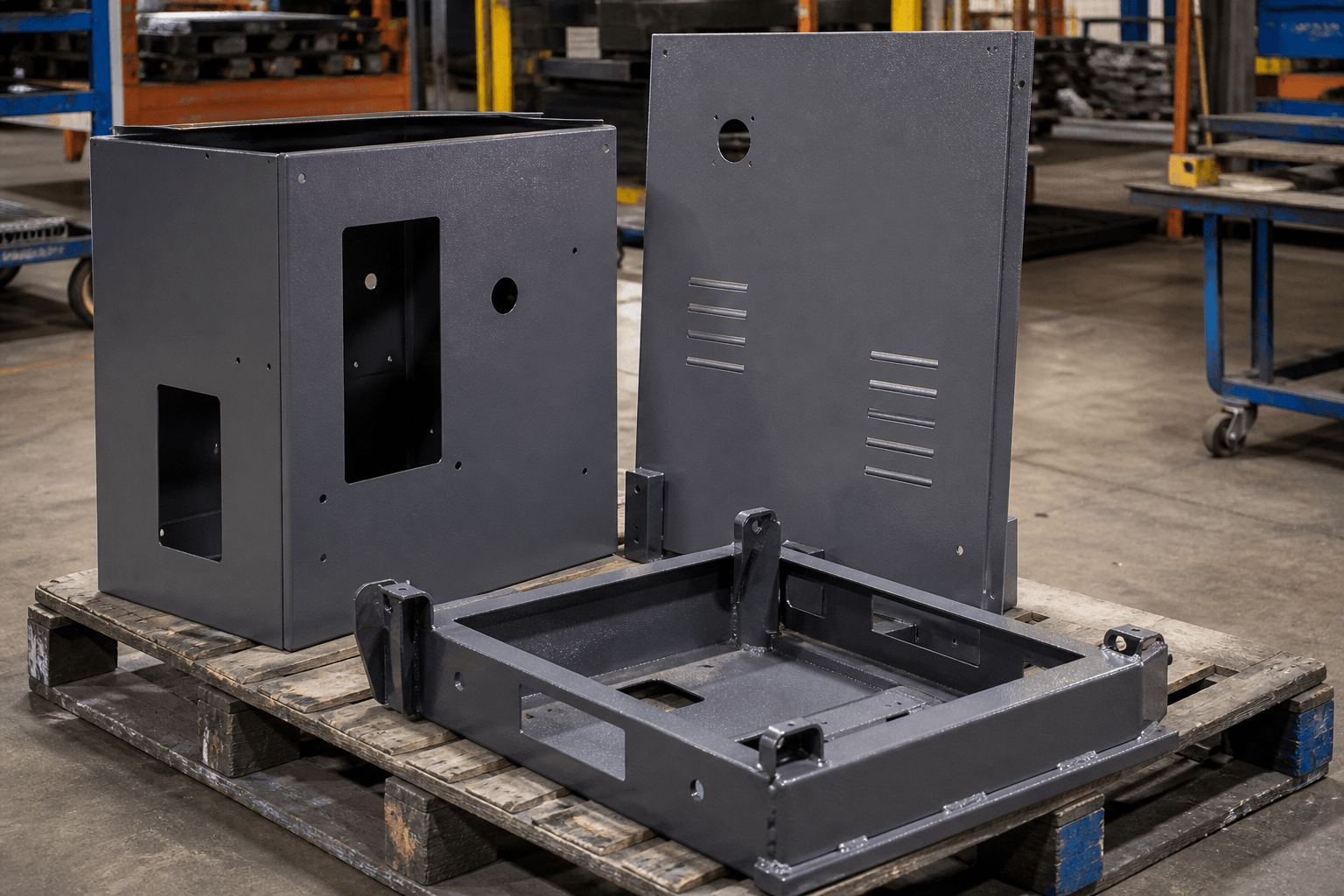
Quick answer: When an OEM drawing says ‘metal powder coated,’ a finisher prepares an already formed or machined metal part, applies dry powder electrostatically, and heats the coating until it melts and cures into a finish film. For a lathe mechanic producing a shaft, spacer, threaded insert, or similar component, the phrase describes a later finishing operation, not the way the part was shaped.
What it does not define: the substrate, pretreatment, color, gloss, texture, coating range, masking, inspection method, or service performance. If these details remain open, suppliers can interpret the same words differently, leaving color variation, coating on a functional surface, or an unclear rejection decision for the buyer to resolve after production. Engineering, procurement, fabrication, finishing, and inspection teams should agree on the missing details in the drawing, finish specification, or purchase documentation.
Keep the route visible when machined components meet custom sheet metal fabrication. Laser cutting, punching, bending, welding, CNC turning, milling, powder coating, assembly, and inspection remain separate operations. The drawing should state whether each component receives coating, requires masking, stays bare, or gets installed after coating.
Powder coating is not powder metallurgy. Powder metallurgy uses metal powder to form the component itself through compaction and controlled heating. Powder coating applies a separate coating material to an already formed part. It also differs from liquid painting, which applies a liquid coating that a finisher then dries or cures.
What the Phrase Defines and Leaves Open
In an OEM description, ‘metal powder coated’ generally means that accessible metal surfaces receive a cured polymer-based powder finish. The approved system can produce a matte, gloss, textured, metallic, or other specified appearance, but the short phrase is not a complete production requirement. A buyer still needs to define which surfaces matter, how the finish may affect interfaces, and what condition the team will accept.
The wording does not identify whether the substrate is carbon steel, stainless steel, aluminum, or another compatible metal. It also leaves open the color reference, gloss, texture, pretreatment, film-thickness requirement, coating system, masking locations, acceptable rack marks, appearance criteria, and service environment. Coverage can vary around internal corners, recesses, folded edges, welds, holes, and shielded faces. If the drawing leaves those areas undefined, a supplier may meet the general finish wording while the part still fails an assembly interface or visual review.
Process Sequence and Sources of Variation
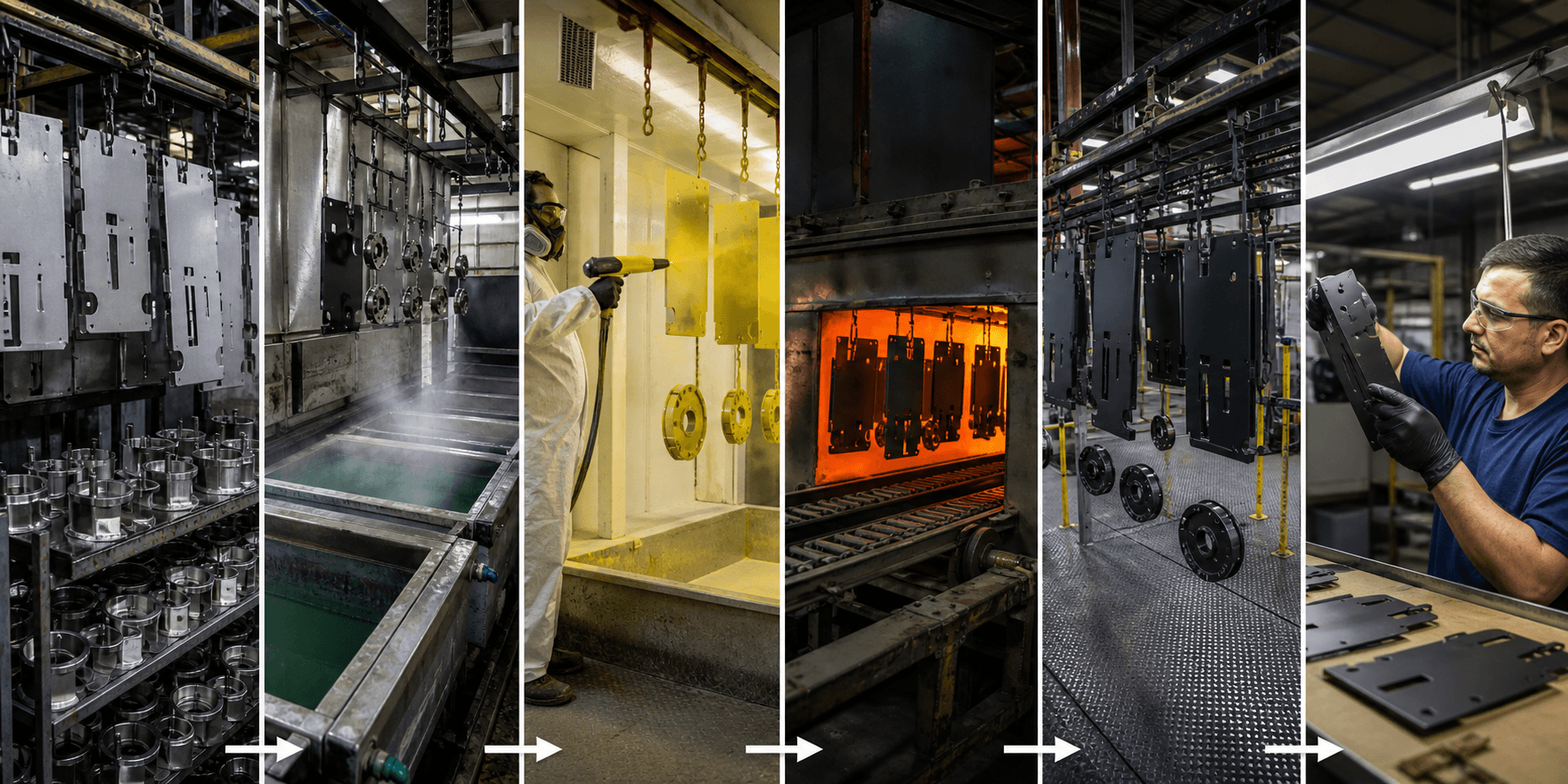
For a buyer, the process sequence identifies where finish risk enters the project. A part that reaches the coating stage with oil, scale, weld spatter, sharp edges, or difficult-to-clean geometry may require additional preparation. If the drawing does not address that condition, the finisher may need clarification, rework, or a revised acceptance decision.
- Condition review: The finishing team checks burrs, sharp edges, weld spatter, scale, oxides, oil, dirt, and other contamination before preparation.
- Cleaning or degreasing: The finisher removes processing oils and residues. Contamination trapped in joints, recesses, or weld areas can spoil appearance or weaken bonding.
- Substrate-specific pretreatment: The finisher selects preparation for the metal and coating system. Where required, this stage removes or conditions oxides and other surface contamination. The chemistry and sequence should come from the approved process specification or coating supplier information.
- Masking and racking: If the drawing requires bare threads, grounding pads, sealing faces, bearing locations, or other functional areas, the team masks them before coating. Rack contact can leave a small mark or uncoated location, so the drawing should identify acceptable rack positions.
- Electrostatic application: The operator applies charged dry powder to the grounded part. Geometry and orientation affect access to recesses and shielded areas, so a general statement of coating coverage may not be enough.
- Heating and curing: The selected powder system’s technical documentation sets the heating and curing conditions. The result also depends on powder type, substrate, part mass, geometry, and the approved process window.
- Cooling and inspection: After the part cools, the inspector checks appearance, coverage, masking, rack marks, and functional interfaces against the agreed requirements.
Poor cleaning or inadequate pretreatment can weaken adhesion and reduce the intended corrosion protection. Weld spatter, sharp edges, and poor edge preparation can create visible defects or inconsistent edge coverage. An uncontrolled film build can reduce clearance, while a missed cure window can change film formation, hardness, adhesion, or appearance. Define project values for the selected coating system instead of borrowing limits from a generic guide.
Turn the Finish Phrase into a Drawing Requirement
A production-ready finish note closes the assumptions that otherwise move between procurement, machining, fabrication, finishing, and inspection. Define the following before prototype approval or batch release.
| Requirement | What to define | Why it matters |
|---|---|---|
| Base material | Alloy or grade, thickness, and welded, machined, or assembled condition | Substrate and condition affect preparation, pretreatment, handling, and heat response. A mismatch can lead to unsuitable preparation or process rework. |
| Coated surfaces | All exposed surfaces, selected faces, or marked coating zones | An unstated surface may arrive bare or coated when the assembly expects the opposite. |
| Color, gloss, texture | Documented color reference or approved sample, plus gloss and texture | Words such as ‘black’ or ‘gray’ do not define visual acceptance and can create avoidable batch rejection. |
| Coating system and range | Approved powder system and a minimum or maximum film-thickness range where fit or performance requires it | Different systems and coating builds can affect cure, appearance, and dimensions. Excess build may interfere with assembly. |
| Pretreatment | Required preparation or a reference to the approved process specification | Pretreatment forms part of the finish system. Omitting it can leave the supplier without a clear basis for adhesion or corrosion requirements. |
| Masking and rack marks | No-coat zones, permitted rack locations, and acceptable visibility | Undefined masking can put coating on assembly, electrical, sealing, or appearance-critical surfaces and create rework. |
| Service environment | Indoor or outdoor use, humidity, chemicals, temperature exposure, and handling | Without exposure information, a visually acceptable finish may not match the part’s functional environment. |
| Inspection and appearance class | Visual criteria, viewing conditions, dimensions after coating, and any agreed performance tests | Post-coat checks prevent fit problems from moving downstream. Visual approval alone does not prove adhesion, conductivity, cure, or corrosion performance. |
Use this table during early supplier evaluation, before quoting and prototype approval. Closing each field at that stage reduces the chance that a coating assumption becomes assembly rework, a batch-approval dispute, or an unexpected change to the fabrication route.
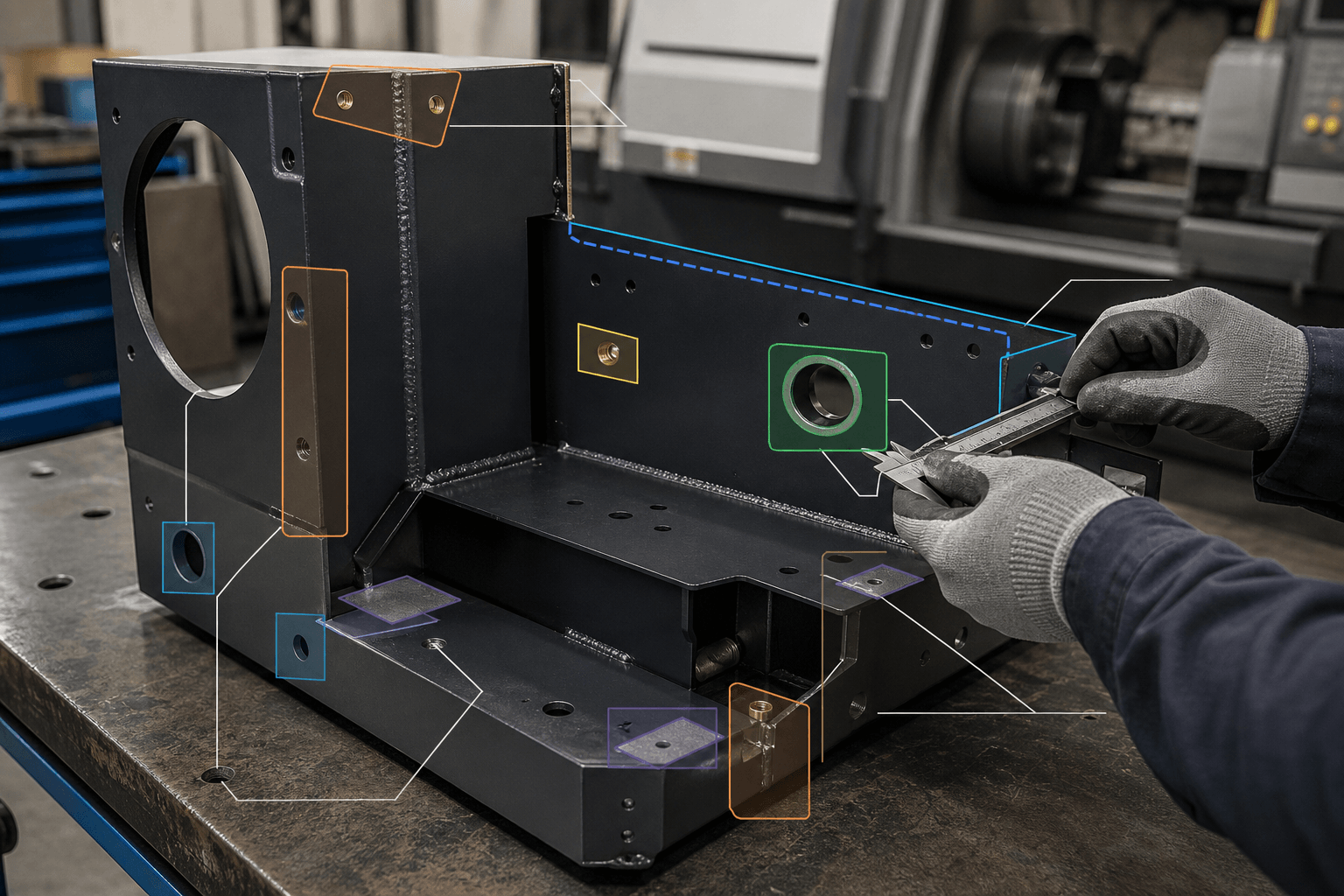
For fit-critical features, identify threads, fastener holes, grounding points, seal lands, press-fit areas, sliding surfaces, and mating faces. Specify masking, post-coat cleaning, or an allowable finished condition. Where coating is allowed but clearance is limited, review the dimensional allowance with the supplier before releasing the drawing.
Consider a turned shaft installed in a powder-coated frame. The frame may receive the finish while a bearing or sliding surface on the shaft remains bare. Machining tolerance does not automatically absorb coating build. If clearance is tight, a part that fits before coating can interfere after coating unless the team reviews allowance and masking at the assembly interface.
For an early project review, Yishang can use the drawing and finish details to identify missing notes before prototype approval. For fabricated parts, custom sheet metal fabrication for powder-coated OEM parts should be reviewed together with the finish and assembly requirements. Enclosures may also require defined masking and assembly surfaces; see powder-coated sheet metal enclosures with defined masking and assembly surfaces.
Choose the Finish and Protect the Interfaces
Compare powder coating with alternatives according to substrate, part size and geometry, heat exposure during cure, appearance, electrical or contact requirements, corrosion environment, repair expectations, production volume, and the fabrication route. A visually attractive finish can still fail if it reaches a grounding pad, changes a tight fit, or cannot meet the service environment.
| Finish | Process distinction | Questions for selection |
|---|---|---|
| Powder coating | A finisher applies dry powder to prepared metal and cures it into a polymer film. | Can the part tolerate the required heat cycle, and which surfaces must remain uncoated? |
| Liquid paint | A finisher applies a liquid coating and then dries or cures it. | Do geometry, heat sensitivity, repair expectations, or appearance requirements favor a liquid system? |
| Electroplating | An electrochemical process deposits a metallic layer. | Are electrical contact, metallic surface properties, thin coverage, or dimensional limits more important than a polymer film? |
| Anodizing | An aluminum conversion process modifies the surface. | Does the aluminum substrate and required appearance suit the process and masking conditions? |
| Galvanizing | Galvanizing provides a zinc layer on steel as a different form of protection. | Does the steel part and environment call for zinc protection, and can any subsequent coating compatibility be validated? |
Galvanizing and powder coating may sometimes serve as separate or combined protection systems, but compatibility and pretreatment require project validation. An electrical contact or metallic-surface requirement may instead point toward plating or a defined uncoated contact zone.
The selection matrix does not replace a design review. Check coating access alongside cutting or punching, bending, welding, machining, hardware installation, and final assembly. Threads, holes, grounding pads, flanges, gasket lands, slots, close-fitting panels, and press-fit features may need masking or a reviewed clearance allowance. Weld spatter, residue, abrupt profiles, sharp corners, and internal corners can affect coverage and appearance. Place rack contact on concealed or nonfunctional locations where possible, and document those locations.
For structural products, identify faces that control squareness, fastening, alignment, or contact after finishing. This is relevant when evaluating powder-coated metal frames for OEM assemblies.
Inspect and Approve the Finished Part
Inspection should separate visual approval from functional verification. A part can match an approved color and still have coating on a thread, grounding point, or mating face, so the buyer must define both appearance checks and post-coat function.
- Confirm identity: Check material, revision, finish description, approved coating system, and masking instruction against the released documentation.
- Review appearance: Compare color, gloss, and texture with the approved sample or documented reference under agreed lighting and viewing conditions.
- Inspect coverage: Examine visible faces, edges, corners, recesses, and welds for bare areas, contamination, runs, pinholes, inconsistent texture, or unacceptable rack marks.
- Check functional zones: Verify threads, holes, grounding pads, contact faces, seals, and mating surfaces.
- Verify dimensions: Measure fit-critical dimensions after coating where the finish could affect assembly. If film build forms part of the requirement, use a project-agreed method to check it.
- Apply defined tests: When the application requires it, use an agreed method and acceptance requirement for adhesion, hardness, cure, conductivity, or corrosion performance.
- Record approval: Retain the approved sample identification, finish specification, inspection results, and nonconformance disposition needed for repeat production.
Agree on viewing distance, lighting, visible-face priorities, defect limits, sample approval, and batch-to-batch comparison before production. A supplier’s quality control and inspection of finished powder-coated metal products can form part of that review. Visual inspection alone does not establish long-term service performance, corrosion resistance, adhesion, conductivity, or cure.
For an OEM project review, send Yishang the 2D or 3D drawings, relevant BOM information, base material and thickness, welded or machined condition, color reference, gloss or texture requirement, approved sample information, masking and grounding requirements, service environment, inspection criteria, and estimated prototype and batch quantities. Yishang can review whether the specified finish fits the custom sheet-metal and machining route, clarify missing drawing requirements, and support prototype review through batch production.
Frequently Asked Questions
Is metal powder coated the same as powder metallurgy?
No. Powder coating finishes an already formed part. Powder metallurgy forms the component through a separate manufacturing route using metal powder.
Is powder-coated metal the same as painted metal?
Both are surface finishes, but powder coating applies dry powder that melts and cures, while liquid painting applies a liquid coating that is then dried or cured. Suitability depends on the part and service requirements.
Can every type of metal be powder coated?
No. Compatibility depends on the alloy, surface condition, pretreatment, powder system, geometry, and heating requirements. Confirm the specific part and application.
Will powder coating cover holes, threads, grounding points, or mating surfaces?
It may affect or partially cover them unless the drawing defines masking, post-coat cleaning, or an allowable finished condition. Identify functional surfaces explicitly.
Does powder coating make metal corrosion-proof?
No finish is universally corrosion-proof. Performance depends on the substrate, preparation, pretreatment, coating system, film condition, environment, edges, joints, and service damage. Specify and verify required performance using an agreed project method.