
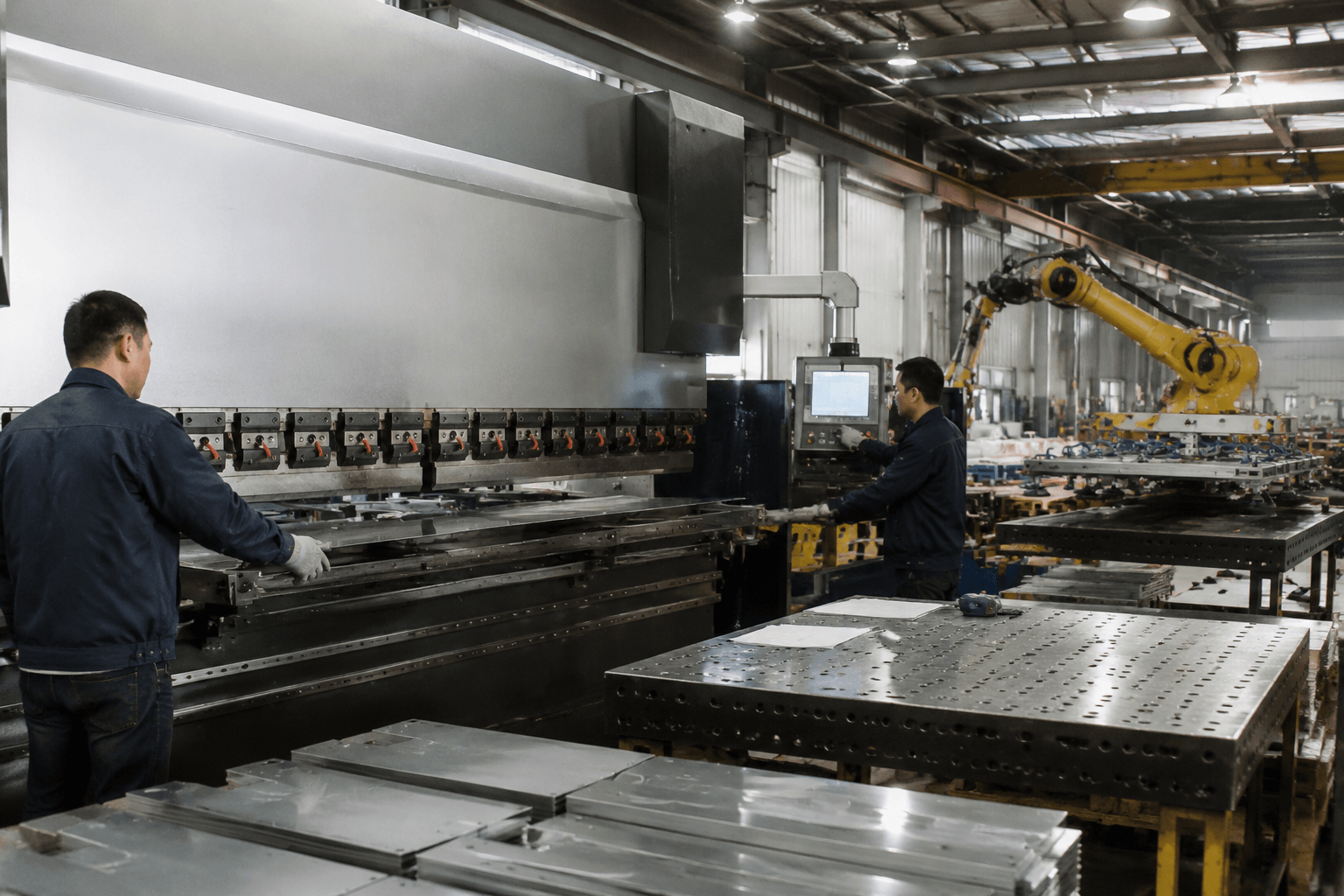
Metal fab equipment is not one machine or a universal workshop checklist. It is the coordinated set of machines, hand tools, fixtures, utilities, material-handling systems, and inspection instruments used to cut, form, join, prepare, and verify metal products. The right setup depends on material type and thickness, workpiece size, geometry, order volume, takt time, tolerance, repeatability, and facility conditions.
When an overseas OEM team is deciding whether to buy a press brake, add CNC cutting, or outsource a welded frame, the decision starts with the product and its production pattern—not with a catalog. A setup suited to occasional prototypes may be inefficient for repeat batches, while a highly automated line can be difficult to justify when designs change frequently.
This guide follows the fabrication workflow from incoming sheet, plate, tube, or profile through cutting, forming, joining, preparation, handling, and inspection. It also explains where manual tools, CNC fabrication equipment, automation, or an external manufacturing partner may fit the workload.
What Counts as Metal Fabrication Equipment?
A buyer reviewing equipment for an enclosure, frame, or other fabricated assembly needs to look beyond the headline machine. Metal fabrication equipment includes the production machines and supporting resources that change the shape, position, or assembly state of sheet, plate, tube, profile, and structural sections. Depending on the product, that may include shears, saws, plasma or laser systems, CNC punches, press brakes, welding power sources, fixtures, handling aids, utilities, and calibrated measuring instruments.
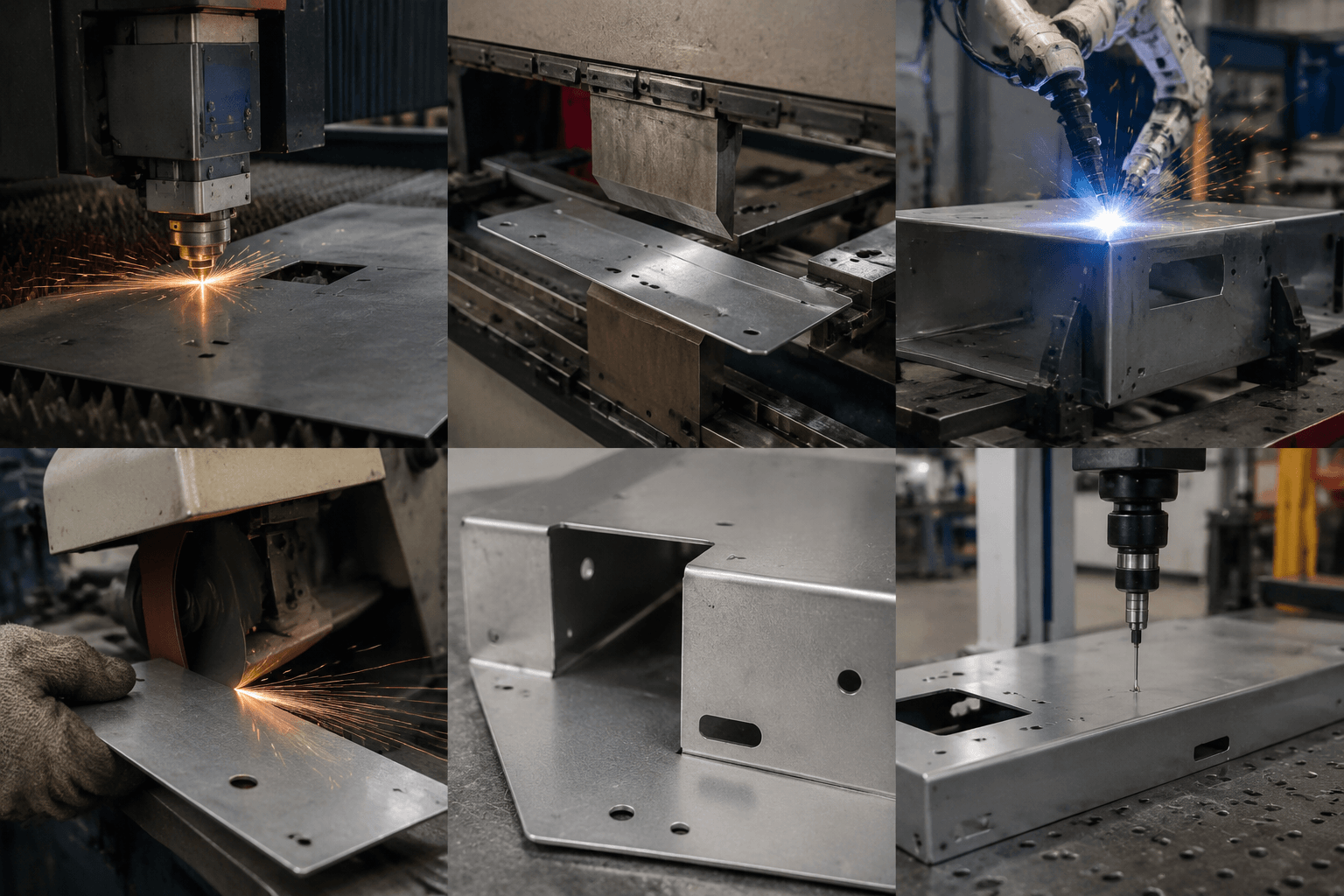
A typical fabrication workflow is material preparation and cutting → forming → joining and fit-up → deburring or surface preparation → inspection. Handling and fixturing support several stages rather than belonging to only one point in the sequence. Assembly and packing support may also be part of the setup when the fabricated product must arrive ready for installation or integration.
Hand tools are part of the metal fabrication tools landscape, but they serve a different production purpose from dedicated production machines. Portable shears, drills, grinders, files, clamps, layout tools, and manual forming equipment can be appropriate for prototypes, repairs, one-off parts, short runs, and products that change frequently. A manual machine can still be a production asset; the distinction is its level of repeatability, setup control, labor dependence, and output consistency, not whether it has a computer attached.
Product form also sets an important boundary. Sheet metal fabrication equipment emphasizes blank cutting, punching, bending, and controlled assembly. Tube and profile work may require saws, tube-processing tools, frame fixtures, and accessible welding equipment. Lathes and general CNC machining centers primarily remove material from solid stock to create turned or milled geometry. Those parts may interface with a fabricated assembly, but CNC turning and milling are not sheet metal fabrication processes.
Equipment Along the Fabrication Workflow
A drawing may show one finished assembly, but its production route usually contains several controlled handoffs. Cutting creates a usable blank, forming establishes geometry, joining fixes the assembly, and preparation and inspection determine whether the result can be handled, assembled, and checked against the drawing. Equipment selection is easier when each stage is evaluated in that sequence.
| Workflow stage | Typical equipment | Key specifications and selection factors | Common production risks |
|---|---|---|---|
| Material preparation and cutting | Layout tools, shears, band or cold saws, plasma systems, laser cutting systems, CNC punching, and portable drills for secondary holes | Material and thickness range, cutting capacity, effective work area, geometry, hole requirements, edge quality, machine power, nesting, duty cycle where relevant, and consumable life | Burrs, heat-affected areas, rough edges, incorrect blanks, poor nesting, and downstream fit problems |
| Forming | Press brakes, manual brakes, rolls, presses, forming tools, gauges, and workpiece supports | Bend length, available forming force, tooling compatibility, flange geometry, material behavior, effective work area, positioning accuracy, repeatability, and setup frequency | Springback, bend-angle variation, marking, cracking, incorrect bend sequence, and accumulated dimensional error |
| Joining and fit-up | Welding power sources, torches, feeders where applicable, resistance welding equipment when relevant, clamps, welding fixtures, positioners, and assembly tables | Joint design, alloy, material thickness, access, duty cycle, heat input, fixture rigidity, production volume, and the required level of manual or automated control | Weld shrinkage, distortion, poor penetration, difficult access, inconsistent joint location, and frame misalignment |
| Deburring and surface preparation | Files, hand grinders, belt finishing machines, abrasive tools, edge-rounding equipment, and cleaning tools | Required edge condition, surface sensitivity, abrasive grade, consumable life, dust extraction, operator access, and later coating or assembly requirements | Sharp edges, inconsistent surface treatment, excessive material removal, scratches, contamination, and hidden burrs |
| Fixturing and material handling | Worktables, locating fixtures, clamps, carts, racks, lifting aids, and part supports | Load capacity, datum strategy, fixture rigidity, locating repeatability, safe access, part protection, and movement between workstations | Datum errors, handling damage, unsafe lifting, fixture deflection, and inconsistent positioning |
| Inspection | Calipers, micrometers, height gauges, angle tools, gauges, surface plates, templates, and other application-appropriate instruments | Feature type, tolerance, measurement uncertainty, access, calibration control, sampling plan, and record requirements | Inspection gaps, unsuitable instruments, missed process drift, and incomplete batch records |
| Utilities and process support | Electrical distribution, compressed-air systems, fume or dust extraction, process-gas equipment, lighting, and fire-protection provisions | Machine demand, air quality and capacity, extraction requirements, gas storage, floor space, access, noise, maintenance needs, and local facility requirements | Power interruptions, poor extraction, gas-handling problems, installation constraints, and unsafe or inefficient workflow |
Applied finishes belong to a separate downstream decision. Powder coating and other coating systems have their own preparation, application, curing, environmental, and inspection requirements, so they should not automatically be included in a metal fabrication equipment plan unless the project requires internal finishing.
Match the Setup to Workload, Material, and Geometry
A procurement team may have one enclosure family, several frame sizes, and an uncertain forecast. That mix calls for a different balance of flexibility, repeatability, and automation than a standardized part family with stable orders. Start with material, thickness, maximum part size, geometry, volume, takt time, tolerance, and repeatability, then map those needs to internal equipment and external processes.
A sound metal fabrication equipment selection process reviews specification categories together. For cutting, compare cutting capacity, effective work area, machine power, edge-quality requirements, nesting needs, and consumable life. For forming, consider the bend envelope, tooling range, positioning accuracy, load capacity, and changeover effort. For joining, duty cycle, heat control, fixture access, and maintenance needs may matter more than the power-source label. Across the setup, also review automation level, programming requirements, loading, extraction, inspection access, and service support. Nominal capacity alone does not show whether a part can be loaded, positioned, processed, and checked consistently.
| Production situation | Equipment pattern | What it can support | Main decision or production risk |
|---|---|---|---|
| Prototype, repair, or one-off work | Hand tools, manual cutting and forming equipment, flexible workholding, and outsourced specialist operations | Fast design changes, unusual geometries, small quantities, and repair work | Manual variation may require additional checking, adjustment, and rework. Some cutting or forming requirements may exceed the flexible setup. |
| Low-volume custom production | Manual equipment supported by selected standalone production machines and reusable fixtures | A mix of recurring and changing parts without a dedicated line | Identify setup delays, scrap, and operator-dependent variation before adding CNC fabrication equipment. |
| Repeat OEM batches | CNC cutting or punching, controlled forming, repeatable fixtures, stored programs, and structured inspection | Stable part families, recurring orders, and controlled batch production | Demand must support programming, tooling, maintenance, trained labor, and adequate utilization. |
| Higher-volume, standardized products | Integrated CNC equipment, automated loading or handling, dedicated tooling, and selective welding automation | Stable designs with repetitive operations and predictable material flow | Automation must accommodate changeovers, part variation, inspection, exceptions, and periods of lower demand. |
| Variable or uncertain demand | Outsourced fabrication or a manufacturing partner with several linked processes | Prototype and batch production without building a complete internal equipment stack | Drawings, quality expectations, packaging, logistics, and demand forecasts must be clear enough to coordinate external production. |
Material changes the process window. Carbon steel may require attention to heat input, edge condition, oxidation, forming response, and weld shrinkage. Stainless steel can be more sensitive to heat tint, surface scratches, and contamination during handling or joining. Aluminum transfers heat quickly and may require careful control of distortion, clamping, and joining conditions; reflectivity and thermal behavior can also affect some laser applications. These are selection factors, not reasons to choose a machine based only on an alloy label. The actual grade, thickness, geometry, required surface condition, and joint design remain decisive.
Part geometry should be evaluated in the same way. A flat blank with a simple hole pattern places different demands on equipment than a large formed enclosure, a tube frame, or a welded assembly with tight mating interfaces. For custom sheet metal enclosures, bend sequences, cutout positions, cosmetic surfaces, hardware interfaces, and assembly fit need to be considered as one connected process rather than as isolated machine tasks.
Facility Conditions and Total Ownership Cost
The price on an equipment quote does not by itself represent the cost of ownership. A realistic evaluation includes tooling, replacement consumables, process gases, electricity, software, fixtures, operator training, calibration, spare parts, maintenance, external service, and downtime. Programming, setup, material movement, inspection, rework, and changeovers also consume labor and floor space.
Facility readiness can determine whether equipment is practical to install. Review the electrical supply, compressed-air quality and capacity, ventilation, dust or fume extraction, gas-cylinder storage, fire protection, noise control, floor loading, installation access, maintenance clearance, and space around the work envelope. The layout should allow material to move from storage through cutting, forming, fit-up, inspection, and packing without unnecessary backtracking, unsafe crossings, or repeated lifting.
Compare total cost of ownership with the cost and risk of outsourcing under a realistic demand scenario. Stable orders and high utilization can support ownership, while irregular demand, frequent design changes, limited technical staffing, or substantial infrastructure work can favor external processing. Utilization and order continuity matter because a technically suitable machine can become an underused asset or a bottleneck when the product mix changes.
Part Quality Depends on More Than Machine Capability
The equipment decision becomes a quality decision when parts must fit together across a batch. Cutting can leave burrs or heat-affected areas, forming introduces springback, and several bends can accumulate dimensional error. Welding adds localized heat and shrinkage, while deburring may vary with operator technique. A fixture with an incorrect datum can also hold every part in the wrong position with apparent repeatability.
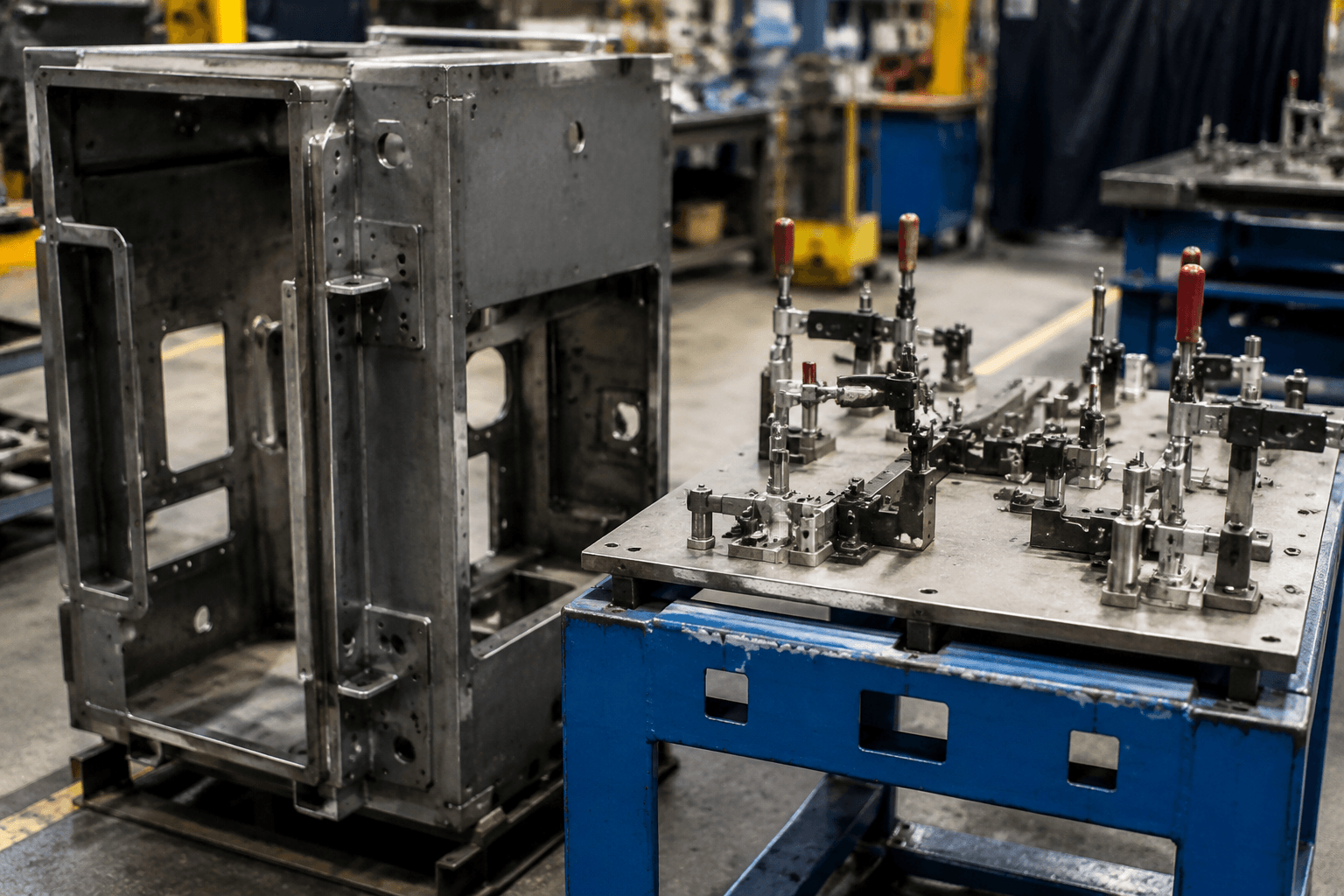
Hypothetical scenario: accurately cut tube sections can still produce an out-of-square frame if the fixture datums are incorrect, clamps allow movement, or the welding sequence concentrates heat on one side. A suitable fixture, controlled sequence, in-process checks, and post-weld inspection address different parts of that risk. Equipment for custom metal frames should therefore be evaluated together with workholding, assembly method, and dimensional verification.
Repeatable OEM production normally links equipment settings and programs with first-article review, in-process measurement, calibrated inspection tools, final checks, and appropriate batch traceability. An inspection plan should cover the features that affect fit, function, appearance, and assembly—not merely the dimensions that are easiest to measure. A defined quality control process helps connect machine output to drawing requirements and detect process drift before it affects an entire batch.
A manufacturing partner may be more practical than an internal equipment stack when one product family would require several linked machines, custom fixtures, trained operators, inspection controls, and variable utilization. The relevant question is whether the partner can manage the complete fabrication route and communicate quality results, not whether its capability list contains a particular machine.
A Practical Buy, Upgrade, or Outsource Sequence
Before approving a machine or assigning a project externally, a project team should turn the drawing and forecast into a clear production-responsibility decision. Use the following sequence to separate a genuine capacity need from an equipment preference.
- Define the product mix. Separate sheet, plate, tube, profile, and solid machined parts. Record materials, thickness ranges, maximum workpiece dimensions, geometry, joining needs, surface requirements, and assembly interfaces.
- Quantify demand. Compare prototype quantities, recurring batch sizes, forecast stability, changeover frequency, and required takt time. Do not justify automation using peak demand alone if the equipment will otherwise be idle.
- Identify critical features. Focus on bend relationships, hole-to-edge locations, weld datums, frame squareness, cosmetic surfaces, mating interfaces, tolerances, and inspection access. These features often determine tooling and fixture requirements.
- Check facility and staffing readiness. Confirm utilities, extraction, floor space, safe material flow, maintenance support, programming resources, operator skills, and inspection capability before selecting a machine.
- Compare complete costs. Model equipment, installation, tooling, consumables, labor, service, downtime, quality losses, and capacity risk. Compare the result with external processing or fully outsourced production rather than with a machine purchase price alone.
- Assign production responsibility. Buy when demand, utilization, skills, and process controls support ownership. Upgrade from manual to CNC when recurring setup, positioning variation, or capacity constraints justify the added system. Delay investment or outsource when volumes are uncertain, several linked processes are missing, or specialist controls would be difficult to maintain.
Choosing equipment for an internal workshop means accepting responsibility for utilities, maintenance, staffing, safety, quality control, and utilization. Choosing an OEM partner means confirming that its overall workflow fits the design, quantity, inspection, packaging, and delivery requirements. Neither route is automatically better; the fit between the product and the production responsibility is the deciding factor.
Yishang can review whether a custom sheet metal or welded-product project is better suited to its OEM or ODM manufacturing workflow, prototype review, and batch production model. For a project-fit consultation, share the part drawings or 3D files, material and thickness range, approximate prototype and production quantities, critical dimensions, tolerances, finish and assembly requirements, target delivery region, and any packaging or shipping constraints. Yishang has experience exporting custom metal products to more than 50 countries.
When comparing external custom sheet metal production with a new internal equipment setup, evaluate the complete workflow rather than the machine price alone.
Frequently Asked Questions
For OEM teams reviewing drawings, quantities, and prototype requirements, these questions help clarify the boundary between internal metal fabrication equipment and outsourced production.
What is the difference between metal fabrication equipment and CNC machining equipment?
Metal fabrication equipment primarily cuts, bends, joins, and prepares sheet, plate, tube, or profile material. CNC machining equipment removes material from solid stock to create milled or turned geometry. A CNC laser, punch, or press brake can be fabrication equipment, while a general CNC mill or lathe belongs to the machining boundary. The processes may be combined in one product, but they are not the same equipment category.
Which equipment is most important for a small metal fabrication workshop?
There is no universal starting list. For many small workshops, safe material handling, measurement tools, workholding, suitable cutting and joining tools, deburring equipment, and extraction form the practical foundation. Forming or CNC cutting equipment may be essential for one product mix but unnecessary for another. Specialist cutting, bending, or finishing can remain outsourced until recurring demand supports ownership.
When should an OEM shop upgrade from manual tools to CNC fabrication equipment?
Consider an upgrade when recurring parts experience long setup times, inconsistent positioning, excessive rework, or insufficient capacity, and when forecast utilization can support programming, tooling, maintenance, and training. CNC control can improve repeat positioning and reduce setup variation, but fixtures, process settings, inspection, and competent operation remain necessary.
Is it more cost-effective to buy fabrication equipment or outsource custom sheet metal production?
Neither option is universally cheaper. Ownership may suit stable demand, high utilization, available skills, and a process that is strategically important to the business. Outsourcing may be more practical for variable orders, prototypes, specialized equipment needs, or products requiring several linked operations. Compare total ownership cost, capacity risk, quality responsibility, logistics, supplier-coordination effort, drawing requirements, tolerances, finish, and quantity.
Planning a prototype or repeat batch? Share the drawings, material and thickness, quantities, critical tolerances, finish, assembly needs, delivery region, and packaging constraints so Yishang can assess the fit of its OEM or ODM workflow.