
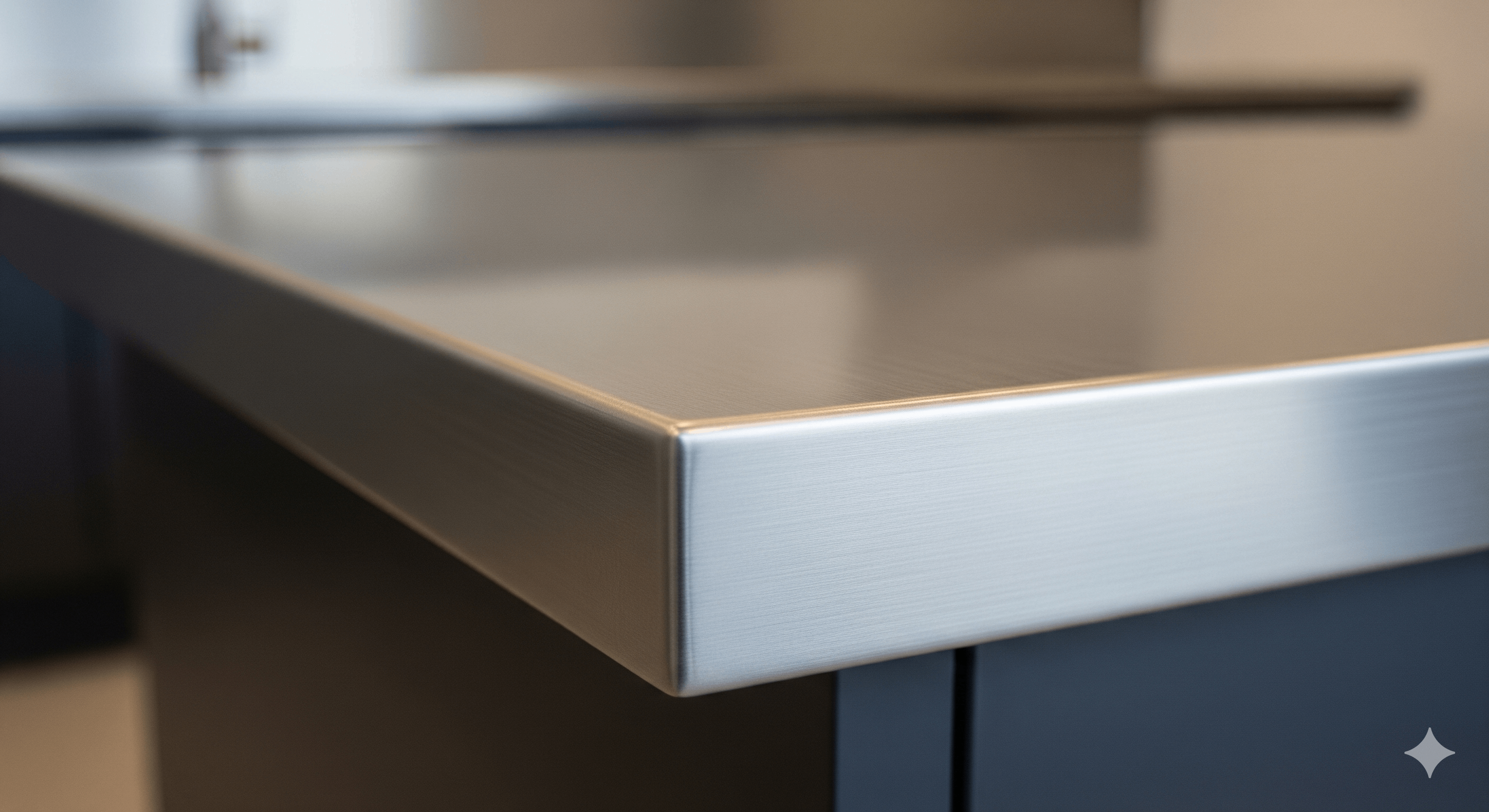
In the professional landscape of global metal procurement, a stainless steel countertop is far more than a simple utilitarian surface. For an overseas procurement manager, a product’s “value” is not determined by its initial luster. Instead, it depends on long-term structural integrity and engineering precision. Countertops in high-traffic commercial kitchens or sterile medical laboratories are sophisticated systems. These units must withstand decades of mechanical stress and extreme heat. Furthermore, they must maintain perfect hygiene standards despite aggressive chemical exposure.
The difference between a “commodity-grade” surface and a “precision-engineered” system lies in the invisible details of fabrication. At YISHANG, we leverage over 26 years of specialized experience. We understand that B2B clients prioritize risk mitigation and total cost of ownership (TCO) above all else. Consequently, this guide deconstructs the engineering manifesto of stainless steel fabrication. We provide the technical insight necessary for professional buyers to make informed, data-driven decisions. These insights secure your supply chain and satisfy end-users over a 30-year lifecycle.
Phase 1: Material Forensic — The Foundation of Procurement Security
For an international wholesaler, material quality is the most significant “hidden risk” in the procurement cycle. Specifically, in a market where Grade 304 and 316 are treated as generic labels, chemical consistency dictates product longevity. A minor deviation in alloy composition might not be visible upon delivery. However, it will manifest as localized pitting or stress corrosion cracking during field use. As a result, the distributor may face catastrophic brand damage and expensive field recalls. These costs often exceed the initial purchase value tenfold due to labor and re-installation expenses.
The Metallurgical Integrity of Grade 304 and 316
Grade 304 (UNS S30400) remains the global standard for most commercial applications. This is due to its balanced mechanical properties. Nevertheless, understanding specific Chromium and Nickel thresholds is critical for high-stakes projects. Chromium provides the essential “self-healing” passive layer. Meanwhile, Nickel ensures the austenitic structure necessary for deep drawing and welding. For maritime or medical environments, Grade 316 (UNS S31600) is the non-negotiable choice. This grade offers enhanced resistance to pitting in chloride-rich atmospheres.
Grade 316 is enhanced with 2.0-3.0% Molybdenum. Therefore, it provides a specialized engineering requirement for resistance against chloride-induced corrosion. At YISHANG, we emphasize that selecting the right alloy is the first step in managing risks. We help wholesalers avoid the common pitfalls of “material degradation.” This often occurs with low-cost, unverified alternatives in the global market. Our procurement protocols ensure that every sheet of material strictly adheres to the chemical requirements of the ASTM A240 standard.
| Chemical Component | Grade 304 (Standard) | Grade 316 (Marine/Medical) | Procurement Impact |
|---|---|---|---|
| Chromium (Cr) | 18.0 – 20.0% | 16.0 – 18.0% | Core of the passive oxide film for corrosion resistance. |
| Nickel (Ni) | 8.0 – 10.5% | 10.0 – 14.0% | Dictates ductility and resistance to oxidation. |
| Molybdenum (Mo) | N/A | 2.0 – 3.0% | Critical for neutralizing chloride-rich environments. |
| Carbon (C) | < 0.08% | < 0.08% | Low carbon levels minimize carbide precipitation. |
The Critical Role of the Mill Test Certificate (MTC)
A professional fabricator does not rely on visual inspection alone. Instead, we rely on material traceability. The Mill Test Certificate (MTC) is the only document that guarantees the mechanical properties of the steel. For wholesalers, the MTC acts as a tool for quality assurance. It allows engineers to predict how the metal will react to high-pressure bending or fiber laser cutting. Consequently, this ensures dimensional consistency across bulk orders of 1,000 units. This precision is vital for seamless on-site installation by your clients.
At our facility, every batch of material is cross-referenced with its MTC. We ensure that the “spring-back” during CNC bending is calculated with 0.1mm precision. This prevents assembly issues for the end-user. Furthermore, this forensic approach to raw material minimizes the risk of structural failure. We ensure that every stainless steel work surface meets the rigorous standards of global procurement teams. By auditing the chemical heat analysis, YISHANG provides wholesalers with a verified paper trail. This documentation is crucial for insurance and regulatory compliance in Western markets.
Gauge Selection and the Physics of Deflection
Procurement managers often struggle with the balance between material cost and product durability. In industrial surfaces, this is fundamentally a question of deflection physics and load-bearing capacity. A 14-gauge (1.9mm) countertop provides significantly higher rigidity than a 16-gauge (1.5mm) alternative. When heavy equipment—such as industrial mixers—is placed on a surface, thinner gauges experience higher deflection. Eventually, this can lead to microscopic fatigue at the weld points.
Therefore, we advise our B2B partners to specify gauge based on load requirements rather than cost alone. This ensures the final product does not suffer from structural sagging or “oil canning” over time. This stability is maintained even in heavy-duty commercial environments. By choosing the correct thickness, you protect your clients from the hidden costs of early replacement. In addition, it solidifies your reputation as a provider of high-performance steel countertops. Our engineering team provides technical drawing support to help you calculate exact gauge needs for various industrial loads.
Phase 2: Structural Integrity — Engineering Against “Oil Canning” and Warping
One of the most frequent complaints regarding large-span stainless steel countertops is “Oil Canning.” This phenomenon manifests as visible waviness or buckling in flat sections. Specifically, it is a failure of structural engineering rather than a material defect. Because stainless steel has a high coefficient of thermal expansion, it naturally moves when exposed to heat. Solving this problem requires an internal “skeleton.” This structure allows for microscopic movement while maintaining absolute surface flatness under variable temperatures.
The Engineering Logic of Hat Channel Reinforcement
To eliminate buckling, YISHANG utilizes “Hat Channels.” These are U-shaped stainless steel reinforcement profiles welded to the underside of the surface. Many low-cost manufacturers use wood-core (MDF) substrates to provide rigidity. However, wood-core substrates represent a significant risk for wholesalers. Wood absorbs moisture and swells. It also harbors bacteria, which can lead to hygiene failures and product recalls. Our approach is purely metallurgical. Therefore, we ensure 100% compliance with international health and safety codes.
We engineer all-metal support structures that are fireproof and moisture-resistant. Furthermore, these units are geometrically optimized to distribute weight evenly across the entire span. For the wholesaler, this means fewer warranty claims. Your clients will receive a product that maintains its factory-new flatness for decades. By focusing on all-metal reinforcement, we eliminate the primary cause of warping in stainless steel countertops fabrication. This provides a superior value proposition for your premium clientele.
Acoustic Engineering: Creating a “Dead” Surface
The “drumming” noise associated with stainless steel is a hallmark of poor fabrication. It is also a major deterrent for high-end hospitality or medical laboratory environments. For B2B buyers, the sensory experience of the product reflects its perceived quality. Therefore, we address this through acoustic damping. We integrate sound-absorbent substrates or specialized industrial adhesives between the surface and the reinforcement channels. This process transforms a vibrating metal sheet into a solid, premium surface.
Specifically, this engineering detail provides the solid feel of stone with the unmatched durability of steel. For B2B buyers, this translates into higher user satisfaction. You will hear fewer complaints regarding noisy or cheap-feeling metalwork. By offering a “dead” surface, you position your product line as a high-end alternative to commodity imports. It is these invisible acoustic details that allow our partners to win contracts for prestigious commercial kitchens. These facilities require environmental noise to be kept to a minimum to ensure a productive workspace.
Material Comparison: Stainless Steel vs. Traditional Surfaces
For wholesalers, articulating the comparative advantages of stainless steel is essential for closing large-scale contracts. While stone or composite materials are popular in residential settings, they often fail industrial demands. Natural surfaces simply cannot handle high-volume commercial environments effectively.
| Feature | YISHANG Stainless Steel | Granite / Natural Stone | Epoxy / Solid Surface |
|---|---|---|---|
| Hygiene | Non-porous, antibacterial | Porous (requires sealing) | Can harbor bacteria in scratches |
| Durability | High impact & heat resistance | Prone to cracking/chipping | Low heat resistance (melts) |
| Maintenance | Low (easy to sanitize) | High (regular resealing) | Moderate (stains easily) |
| Longevity | 30+ Years | 10-15 Years (chips) | 5-10 Years (discolors) |
| Recyclability | 100% Recyclable | Zero | Very Low |
By highlighting these metrics, YISHANG enables our partners to shift the focus from “initial cost” to “long-term value.” Consequently, you can demonstrate that stainless steel is the most cost-effective solution over the lifecycle of a facility.
Phase 3: Sophisticated Geometry — Functional Profiles for Professional Environments
For a wholesale distributor, the edge profile and backsplash are more than just design choices. Instead, they are functional specifications that must meet local health and safety regulations. A precision fabricator offers a range of sophisticated geometries that address environmental challenges. This section explores how different profiles impact the maintenance and safety of the final installation.
Advanced Edge Profiles: Marine, Bullnose, and Mitered
- Marine Edge (Anti-Drip): This features a raised perimeter specifically designed to contain spills. Specifically, it is a critical safety feature for chemical laboratories or high-volume kitchens. Liquid containment is a regulatory requirement to prevent floor damage and slip hazards.
- Bullnose Edge: By providing a fully radiused corner, we eliminate sharp edges. This is the profile of choice for healthcare environments. Patient safety and easy cleaning are top priorities in these facilities.
- Precision Mitered Edge: For the luxury hospitality sector, a crisp, 90-degree mitered edge provides a heavy, monolithic appearance. Achieving this requires expert hand-polishing to ensure the joint is undetectable to the touch.
Integration with Industrial Components and Complex Enclosures
Modern industrial countertops often house complex equipment. Whether it is a mount electrical enclosure or a junction box nema, fabrication must allow for precise cutouts. At YISHANG, we utilize 3D design and CAD software. We ensure that every cutout for a push button enclosure or a solar battery enclosure is accurate to the millimeter. Furthermore, this prevents costly on-site modifications that can compromise the stainless steel surface.
Our ability to integrate these components demonstrates our breadth as a full-service manufacturer. We handle everything from simple tables to complex control station enclosures integrated within the work surface. For projects requiring a carbon steel enclosure as a sub-structure, we ensure material compatibility. In addition, we provide specialized solutions for projects where environmental exposure and electrical safety are primary concerns.
Phase 4: The Seamless Joinery — Managing the “Invisible” Risks of Welding
In the medical and food processing industries, the joint determines product success. A mechanical joint using bolts is insufficient for high-sanitation environments. Specifically, it creates microscopic crevices where bacteria thrive. The hallmark of elite fabrication is the fusion-welded joint. This creates a monolithic surface that is structurally superior and safe. Our welding process is designed to minimize risk for the procurement manager by ensuring every joint is a permanent bond.
The TIG Fusion Masterclass: Beyond the Bead
Tungsten Inert Gas (TIG) welding is the most labor-intensive but precise method for joining stainless steel. Unlike MIG welding, TIG allows for a clean, deep-penetration weld with a minimal Heat Affected Zone (HAZ). For wholesalers, the benefit of TIG is twofold. First, it creates a bond as strong as the parent metal. Second, it allows for a seamless finish where the weld disappears after professional grinding and polishing. Consequently, it meets the highest aesthetic standards.
Protecting the Passive Layer: The Critical Role of Passivation
One of the greatest hidden dangers in metal fabrication is the destruction of the chromium oxide layer during welding. When stainless steel is heated, it undergoes sensitization. As a result, it becomes vulnerable to rust at the molecular level. A responsible manufacturer must perform a post-weld Passivation process. By applying a nitric or citric acid treatment, we strip away free iron. This allows the protective passive film to “re-grow.”
For a wholesaler, buying a non-passivated countertop is a ticking time bomb. Therefore, our 26 years of experience ensures that every weld is passivated to meet global anti-corrosion standards. This preventing tea-staining in the field. This process is non-negotiable for projects exposed to high humidity or harsh chemicals. By ensuring the integrity of the passive layer, we provide a product that maintains its performance in restaurant kitchens and laboratories. This protects your profit margins from warranty claims.
Phase 5: Surface Topology — Engineering for RA (Roughness Average)
A countertop’s finish is not just about how it looks to the observer. In professional environments, the surface topology determines how the material interacts with light, chemicals, and bacteria. For a procurement manager, specifying the right finish is essential for meeting regulations and operational needs.
Understanding Ra Values for Sterile Applications
Surface texture is measured by the Ra (Roughness Average) value. In the pharmaceutical and food sectors, an Ra value of less than 0.8μm is often the legal requirement. This ensure the surface is non-porous and easy to disinfect. We achieve this through a multi-stage mechanical polishing process. Specifically, by moving from 80-grit to 320-grit abrasives, we create a surface that is both aesthetically pleasing and clinically cleanable. This meets the standards of NSF/ANSI 2 for food equipment.
By controlling the Ra value, we ensure the metal maintains its heat and rust resistance. We ensure there are no microscopic pits where oxidation can begin. This is vital for industrial enclosure and battery storage projects where environmental exposure is a factor. In addition, we provide a product that is non-porous—ideal for restaurant use. This reduces the need for frequent replacements. Consequently, it provides a better ROI for the wholesaler through increased service life and lower labor costs for cleaning.
Grain Alignment and Visual Continuity in Bulk Orders
In large-scale projects, “grain alignment” is a critical quality control metric that many manufacturers overlook. If brush strokes do not align across different sections, the light will reflect at different angles. As a result, the installation will have a mismatched and unprofessional appearance. This can lead to client rejection and costly re-work for the distributor. At YISHANG, we utilize a “master sheet” tracking system. This ensures that every component is cut and polished in the same direction.
This attention to detail provides a synchronized visual flow across the entire installation. Furthermore, this is true regardless of how many sections are joined. It is this level of professionalism that allows us to maintain long-term partnerships with top-tier design firms. When you partner with YISHANG, you ensure that the final installation looks as good as it performs. We provide the aesthetic consistency that high-end hospitality and corporate clients demand for their signature spaces.
Sustainability and LEED Compliance
As global construction standards shift toward environmental responsibility, recyclability has become a major B2B procurement factor. Architects and developers increasingly look for materials that contribute to LEED certification.
YISHANG stainless steel countertops offer:
- 100% Recyclability: Unlike composite or stone materials, every kilogram of stainless steel can be reclaimed and reused at the end of its lifecycle.
- Low VOC Emissions: Our fabrication process avoids toxic resins or adhesives. Consequently, this ensures superior indoor air quality (IAQ) for hospitals and schools.
- Durability as Sustainability: The 30+ year lifespan of our countertops drastically reduces the environmental footprint. This is superior to materials that require replacement every 5-10 years.
For our wholesale partners, this Green Narrative is a powerful tool. Specifically, it helps when bidding on governmental or high-profile institutional projects that mandate ESG compliance.
Phase 6: Design for Global Logistics — Landed Cost and Damage Mitigation
For an overseas wholesaler, the Landed Cost is the most important financial metric. A cheap countertop that arrives damaged is a poor investment. Furthermore, if it costs 50% of its value in shipping, it becomes non-viable. At YISHANG, we engineer our products with the global logistics chain in mind. We aim to maximize container space. In addition, we ensure the product is protected from the rigors of 30-day sea transits and humidity changes.
Modular Fabrication for Container Optimization
While a monolithic 4-meter countertop is impressive, it often leads to excessive shipping costs and high damage rates. Therefore, we offer Modular Fabrication solutions. Large surfaces are designed in interlocking sections that can be assembled on-site. Using high-precision mechanical joints, these sections maintain 100% structural integrity and a seamless appearance. Specifically, this approach significantly increases container loading efficiency. As a result, it allows for more units per shipment and lower unit freight costs.
The Science of Zero-Damage Packaging
Standard shipping methods are insufficient for precision metalwork. Our export experience has led to the development of a Zero-Damage packaging protocol. Specifically, we focus on structural exoskeletons.
- 70-Micron Protective Film: Applied before fabrication to prevent scratches during the laser cutting and bending process. Consequently, this ensures a flawless surface upon installation.
- Internal Steel Bracing: For oversized units, we build an internal skeleton inside the crate. This prevents any flexing or warping during forklift handling and stacking.
- Fumigated ISPM-15 Crates: Every crate is custom-built with shock-absorbent foam. This ensures the product arrives in pristine condition according to the ISPM 15 international standards.
Expert FAQ: Professional Procurement Insights
Q1: How do you manage large-scale wholesale orders while maintaining ISO 9001 standards? We utilize a digital ERP tracking system. Every component is cross-checked against CAD drawings at three stages: laser cutting, welding, and pre-packaging. Consequently, this ensures unit #1 is identical to unit #1,000 under our ISO 9001 certified management system.
Q2: What is the lead time for custom stainless steel work? Our high-capacity fiber laser systems and automated bending cells allow us to maintain a stable production cycle. Furthermore, we provide detailed project timelines to all our wholesale partners. This ensures your procurement schedule is predictable for your downstream clients.
Q3: Can you integrate custom electrical components into the countertops? Yes. We have extensive experience in fabricating electrical enclosure units. Consequently, we can integrate mounting points for a control station or junction box directly into the countertop structure with perfect precision.
Q4: How do you ensure the price competitiveness of YISHANG products? By optimizing our quality control process and using modular design, we significantly reduce waste and shipping costs. Therefore, we can offer factory-direct pricing that is highly competitive on a global scale without compromising on engineering quality.
Q5: What are the specific cleaning protocols to maintain the passive layer? We recommend pH-neutral cleaners and avoiding chloride-based agents. For industrial environments, periodic re-passivation with a citric acid-based solution can help maintain the chromium oxide layer indefinitely.
Procurement Checklist for B2B Wholesalers
- [ ] Verify Material Grade (304 vs 316) against environmental stressors.
- [ ] Request Mill Test Certificates (MTC) for every batch.
- [ ] Confirm gauge thickness based on expected load-bearing (14-ga vs 16-ga).
- [ ] Ensure post-weld passivation is included in the fabrication process.
- [ ] Specify the required Ra value (e.g., <0.8μm for sterile labs).
- [ ] Review internal reinforcement (hat channel) layout to prevent oil canning.
- [ ] Coordinate modular split-points for logistics optimization.
Contact YISHANG today to discuss your specific requirements. Our engineering team is ready to help you deliver excellence for your next high-performance project.